

Waking up with stiff muscles, tight hips, or a sore back is common, especially after spending several hours sleeping in one position. Starting your day with gentle yoga can help loosen your muscles, improve joint mobility, and prepare your body for daily activities. Yoga for flexibility in the morning is an effective way to stretch different muscle groups while developing better body awareness and balance.
A regular morning yoga routine combines gentle movements, controlled breathing, and stretching exercises to improve flexibility over time. Whether you are a beginner or an experienced yoga practitioner, you can include simple yoga poses in your morning schedule to improve the flexibility of your back, shoulders, hips, hamstrings, and legs.
In this guide, we will explore the best morning yoga poses for flexibility, their benefits, how to perform them correctly, and how to create a simple daily yoga routine.
Why Should You Practice Yoga for Flexibility in the Morning?
Morning yoga is a convenient way to introduce movement into your daily routine. After several hours of rest, your muscles and joints may feel stiff. Gentle yoga movements help you gradually explore your range of motion and prepare your body for everyday activities.
Practicing yoga in the morning also gives you an opportunity to focus on your breathing, improve posture, and develop a consistent exercise habit.
Some important reasons to practice morning yoga include:
- Improves muscle flexibility: Regular stretching helps lengthen muscles and gradually improve your range of motion.
- Reduces morning stiffness: Gentle movements can help loosen tight muscles around the back, hips, shoulders, and legs.
- Supports better posture: Yoga strengthens postural muscles and encourages better body alignment.
- Improves mobility: Stretching the major muscle groups helps you move more comfortably during everyday activities.
- Promotes relaxation: Combining yoga with controlled breathing can help reduce stress and create a calm start to the day.
- Develops body awareness: Yoga encourages you to understand your body’s limitations and move with greater control.
Consistency is more important than performing difficult poses. Even a short morning yoga session can become a useful part of your flexibility routine.
(Also Read: Top And Best Yoga For Increasing Eyesight)
12 Best Yoga Poses for Flexibility in the Morning
You do not need advanced yoga skills to improve your flexibility. Several beginner-friendly yoga poses can gently stretch your muscles and improve mobility.
The following yoga poses target different parts of your body, including the spine, shoulders, hips, hamstrings, thighs, and calves.
1. Cat-Cow Pose (Marjaryasana-Bitilasana)

Cat-Cow Pose is one of the best gentle morning yoga exercises for improving spinal mobility. It involves alternating between rounding and gently extending your spine while coordinating your movements with your breathing.
How to Perform Cat-Cow Pose:
- Begin on your hands and knees on a yoga mat.
- Keep your wrists underneath your shoulders and knees underneath your hips.
- Inhale and gently lower your abdomen while lifting your chest and tailbone.
- Look slightly forward without compressing your neck. This is Cow Pose.
- Exhale and round your spine toward the ceiling.
- Gently tuck your chin toward your chest and draw your abdomen inward. This is Cat Pose.
- Continue alternating between the two positions slowly.
Duration: Perform 8–10 rounds.
Benefits:
- Improves spinal mobility.
- Gently stretches the back and abdominal muscles.
- Reduces feelings of stiffness in the spine.
- Encourages coordination between movement and breathing.
2. Downward-Facing Dog (Adho Mukha Svanasana)

Downward-Facing Dog is a foundational yoga posture that stretches several muscle groups simultaneously. It primarily targets the hamstrings, calves, shoulders, and back.
How to Perform Downward-Facing Dog:
- Begin in a tabletop position with your hands and knees on the mat.
- Spread your fingers and press your palms firmly into the floor.
- Tuck your toes and slowly lift your knees.
- Raise your hips toward the ceiling to create an inverted V shape.
- Keep your spine long and your head relaxed between your arms.
- Bend your knees slightly if your hamstrings feel tight.
- Continue breathing normally while maintaining the position.
Duration: Hold for 20–30 seconds.
Benefits:
- Stretches the hamstrings and calves.
- Improves shoulder mobility.
- Encourages spinal lengthening.
- Strengthens the arms and shoulders.
3. Standing Forward Bend (Uttanasana)

Standing Forward Bend is a useful yoga posture for stretching the back of the legs and releasing tension around the lower back. It can be included in a gentle morning flexibility routine.
How to Perform Standing Forward Bend:
- Stand straight with your feet approximately hip-width apart.
- Keep your knees slightly soft.
- Inhale and lengthen your spine.
- Exhale and slowly bend forward from your hips.
- Allow your upper body to move toward your thighs.
- Let your arms hang naturally or hold your elbows.
- Keep your knees bent as much as needed to avoid excessive strain.
Duration: Hold for 20–30 seconds.
Benefits:
- Stretches the hamstrings and calves.
- Gently stretches the back.
- Improves hip mobility.
- Encourages relaxation.
Beginner Tip: Do not force your hands to touch the floor. You can rest them on yoga blocks or your shins.
4. Low Lunge (Anjaneyasana)

Low Lunge is an excellent morning yoga pose for improving hip flexibility. It stretches the hip flexors and front thigh muscles, which may become tight after prolonged sitting.
How to Perform Low Lunge:
- Start in a tabletop position.
- Bring your right foot forward and place it between your hands.
- Position your right knee above your ankle.
- Lower your left knee gently onto the mat.
- Keep your hips facing forward.
- Slowly lift your chest and raise your arms overhead if comfortable.
- Breathe deeply and maintain the position.
- Repeat on the opposite side.
Duration: Hold for 20–30 seconds on each side.
Benefits:
- Stretches the hip flexors.
- Improves hip mobility.
- Stretches the quadriceps.
- Helps counteract tightness associated with prolonged sitting.
5. Butterfly Pose (Baddha Konasana)

Butterfly Pose is a beginner-friendly seated yoga posture that focuses on the inner thighs, groin, and hips. It is particularly useful for people who spend long hours sitting.
How to Perform Butterfly Pose:
- Sit comfortably on your yoga mat with your legs extended.
- Bend your knees and bring the soles of your feet together.
- Hold your feet or ankles with your hands.
- Allow your knees to move gently toward the floor.
- Sit upright and keep your spine comfortably extended.
- Relax your shoulders and breathe normally.
- Avoid pushing your knees downward with your hands.
Duration: Hold for 30 seconds.
Benefits:
- Stretches the inner thighs.
- Improves hip flexibility.
- Gently opens the groin area.
- Encourages better seated posture.
6. Cobra Pose (Bhujangasana)

Cobra Pose is a gentle backbend that stretches the front of your body and helps improve spinal extension. It can be included in a morning yoga routine to develop greater awareness of spinal movement.
How to Perform Cobra Pose:
- Lie on your stomach with your legs extended.
- Place your palms underneath your shoulders.
- Keep your elbows close to your body.
- Press gently into your palms and lift your chest.
- Keep your shoulders relaxed and away from your ears.
- Lift only as high as you can without compressing your lower back.
- Keep your pelvis grounded and breathe naturally.
Duration: Hold for 15–20 seconds.
Benefits:
- Stretches the chest and abdominal muscles.
- Improves spinal extension.
- Strengthens the muscles of the back.
- Encourages better upper-body posture.
7. Child’s Pose (Balasana)

Child’s Pose is a relaxing yoga posture that gently stretches the back, hips, and thighs. It is also an excellent resting position between more active yoga poses.
How to Perform Child’s Pose:
- Begin on your hands and knees.
- Bring your big toes together.
- Gently move your hips toward your heels.
- Extend your arms forward or rest them alongside your body.
- Lower your forehead toward the mat.
- Relax your shoulders and breathe slowly.
- If your hips do not comfortably reach your heels, place a cushion between your thighs and calves.
Duration: Hold for 30–60 seconds.
Benefits:
- Gently stretches the back.
- Relaxes the shoulders.
- Encourages hip mobility.
- Promotes physical and mental relaxation.
8. Seated Forward Bend (Paschimottanasana)

Seated Forward Bend is a traditional yoga posture that stretches the hamstrings, calves, and back of the body. It is useful for gradually improving flexibility in the posterior muscle groups.
How to Perform Seated Forward Bend:
- Sit on your mat with both legs extended in front of you.
- Keep your feet relaxed and your spine upright.
- Inhale and raise your arms overhead.
- Exhale and slowly bend forward from your hips.
- Reach toward your feet, ankles, or shins.
- Keep your knees slightly bent if your hamstrings are tight.
- Maintain a comfortable position without pulling your body forward forcefully.
Duration: Hold for 20–30 seconds.
Benefits:
- Stretches the hamstrings and calves.
- Improves flexibility in the back of the legs.
- Encourages hip movement.
- Promotes awareness of spinal alignment.
9. Triangle Pose (Trikonasana)

Triangle Pose is a standing yoga posture that stretches the legs, hips, sides of the torso, and shoulders. It also develops balance and body coordination.
How to Perform Triangle Pose:
- Stand with your feet approximately three to four feet apart.
- Turn your right foot outward and slightly turn your left foot inward.
- Extend both arms sideways at shoulder height.
- Shift your hips slightly toward the left.
- Extend your right hand toward your shin, ankle, or a yoga block.
- Raise your left arm toward the ceiling.
- Keep your chest open and avoid forcing your neck to turn upward.
- Repeat on the opposite side.
Duration: Hold for 20–30 seconds on each side.
Benefits:
- Stretches the hamstrings and inner thighs.
- Improves side-body flexibility.
- Encourages hip mobility.
- Develops balance and coordination.
10. Garland Pose (Malasana)

Garland Pose is a deep squat that works on hip, ankle, and groin mobility. It can be helpful for gradually improving lower-body flexibility.
How to Perform Garland Pose:
- Stand with your feet slightly wider than hip-width apart.
- Turn your toes outward slightly.
- Slowly bend your knees and lower your hips into a squat.
- Bring your palms together in front of your chest.
- Place your elbows gently against the inner thighs.
- Keep your chest lifted and spine comfortably extended.
- If your heels cannot reach the floor, place a folded blanket underneath them.
Duration: Hold for 15–30 seconds.
Benefits:
- Stretches the inner thighs.
- Improves ankle and hip mobility.
- Encourages lower-body flexibility.
- Develops balance and stability.
11. Reclining Spinal Twist (Supta Matsyendrasana)

Reclining Spinal Twist is a gentle supine yoga posture that stretches the muscles around the back, hips, and torso. It can be a relaxing addition to your morning yoga sequence.
How to Perform Reclining Spinal Twist:
- Lie flat on your back with your legs extended.
- Bend your right knee and bring it toward your chest.
- Extend your left arm out to the side.
- Gently guide your right knee across your body toward the left.
- Keep both shoulders as relaxed and grounded as possible.
- Turn your head gently to the right only if comfortable.
- Return to the centre and repeat on the other side.
Duration: Hold for 20–30 seconds on each side.
Benefits:
- Gently stretches the back and waist.
- Improves rotational mobility.
- Relaxes the hip muscles.
- Encourages comfortable spinal movement.
12. Extended Side Angle Pose (Utthita Parsvakonasana)

Extended Side Angle Pose is a standing posture that stretches the hips, inner thighs, shoulders, and sides of the torso. It is a useful pose for improving overall flexibility.
How to Perform Extended Side Angle Pose:
- Stand with your feet wide apart.
- Turn your right foot outward.
- Bend your right knee while keeping it aligned over your ankle.
- Place your right forearm gently on your right thigh or your hand on a yoga block.
- Extend your left arm overhead.
- Create a long line from your left foot through your fingertips.
- Keep your chest open and breathe naturally.
- Repeat on the opposite side.
Duration: Hold for 20–30 seconds on each side.
Benefits:
- Stretches the hips and inner thighs.
- Improves side-body flexibility.
- Opens the shoulders and chest.
- Develops leg strength and balance.
(Also Read: 7 Best And Effective Yoga For Spondylitis)
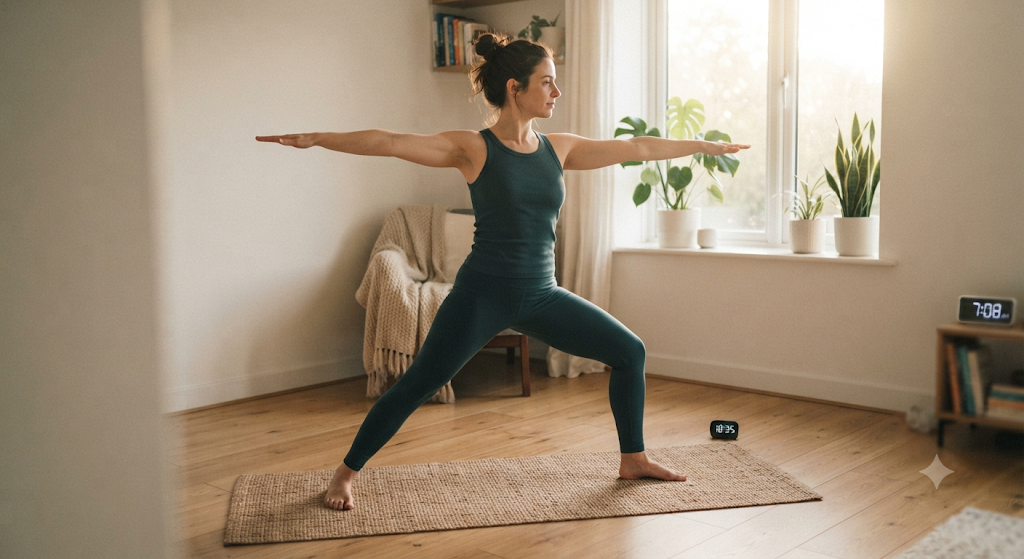
20-Minute Morning Yoga Routine for Flexibility
If you have limited time in the morning, you can combine a few simple yoga poses into a 20-minute routine. This sequence targets the major muscle groups and gradually prepares your body for movement.
Before starting, spend approximately three minutes walking gently around your room or marching in place to warm up your body.
| Yoga Pose | Duration | Main Focus |
|---|---|---|
| Gentle breathing and shoulder rolls | 1 minute | Shoulders and breathing |
| Cat-Cow Pose | 2 minutes | Spine and back |
| Child’s Pose | 1 minute | Back and hips |
| Downward-Facing Dog | 2 minutes | Hamstrings and calves |
| Standing Forward Bend | 2 minutes | Back and hamstrings |
| Low Lunge | 3 minutes | Hip flexors and thighs |
| Butterfly Pose | 2 minutes | Inner thighs and hips |
| Cobra Pose | 1 minute | Chest and spine |
| Triangle Pose | 2 minutes | Legs and side body |
| Reclining Spinal Twist | 2 minutes | Back and hips |
| Relaxation and breathing | 2 minutes | Whole body |
Total duration: 20 minutes
You can adjust the duration according to your comfort and experience. Beginners may perform fewer repetitions and use yoga blocks, cushions, or folded blankets for support.
(Also Read: 11 Effective and Best Yoga For Stress Relief)
Benefits of Practicing Morning Yoga for Flexibility
A consistent morning yoga practice can provide several physical and mental benefits of morning yoga. The results depend on your practice frequency, technique, fitness level, and individual flexibility.
1. Improves Overall Flexibility
Yoga involves stretching different muscle groups through controlled movements and sustained postures. Regular practice can gradually improve the range of motion around your joints.
Poses such as Downward-Facing Dog, Butterfly Pose, and Seated Forward Bend target commonly tight muscle groups.
2. Reduces Muscle Stiffness
Sleeping in one position for several hours may leave certain muscles feeling stiff when you wake up. Gentle morning movements can help you gradually restore comfortable movement.
Cat-Cow Pose, Child’s Pose, and gentle spinal twists are useful options for beginning your day.
3. Supports Better Posture
Poor posture and prolonged sitting can contribute to tightness in the chest, hips, and back. Yoga combines stretching with strengthening and body awareness, which may help you develop better postural habits.
4. Improves Joint Mobility
Yoga encourages controlled movement through different ranges of motion. Gentle hip circles, shoulder movements, and standing poses can help improve mobility when performed appropriately.
5. Helps You Start the Day with More Energy
Morning yoga encourages movement after a period of rest. A gentle sequence can help you feel more awake and physically prepared for your daily activities.
6. Supports Mental Relaxation
Yoga combines physical postures with breathing and attention. This combination may help reduce stress and support emotional well-being.
7. Develops Better Balance and Coordination
Many yoga postures require you to maintain a stable position while moving different parts of your body. Practicing these movements can help develop balance, coordination, and body awareness.
(Also Read: Yoga for Weight Loss: Burn Fat, Build Strength & Transform Mindfully)
Tips to Improve Flexibility Through Morning Yoga
Improving flexibility requires patience and consistent practice. Instead of trying to achieve advanced yoga positions immediately, focus on proper technique and gradual progress.
Here are some useful tips:
- Start with a warm-up: Spend a few minutes walking or performing gentle movements before deeper stretches.
- Practice regularly: Develop a realistic routine that you can follow several times a week.
- Breathe naturally: Avoid holding your breath while performing yoga poses.
- Do not force stretches: Move only as far as you can comfortably manage.
- Use yoga props: Blocks, straps, and cushions can make certain postures more accessible.
- Focus on alignment: Proper posture is more important than reaching the deepest version of a pose.
- Stretch both sides: Practice unilateral poses on both sides to maintain balanced movement.
- Increase gradually: Extend the duration or range of movement as your body becomes more comfortable.
- Stay hydrated: Maintain adequate hydration throughout the day.
- Be patient: Flexibility improves gradually and differs from person to person.
Common Mistakes to Avoid During Morning Yoga
Although yoga can be beneficial, incorrect practice may cause unnecessary strain. Avoid the following mistakes when performing morning yoga for flexibility.
Skipping the Warm-Up
Your body may feel stiff after waking up. Starting with intense stretches without preparing your muscles can make the practice uncomfortable. Begin with gentle movements and gradually increase the intensity.
Forcing Your Body into Deep Stretches
Trying to touch your toes or achieve a complete split is not necessary for improving flexibility. Pushing beyond your comfortable range can strain muscles and joints.
Holding Your Breath
Breathing is an important part of yoga. Avoid holding your breath while maintaining a posture. Use slow, natural breathing throughout your practice.
Ignoring Proper Alignment
Incorrect alignment can place unnecessary pressure on your knees, shoulders, hips, and lower back. Learn the correct technique before increasing the difficulty of a pose.
Practicing Without Consistency
Practicing intensely once a week is generally less useful for building a sustainable flexibility habit than following a manageable routine regularly.
Comparing Your Flexibility with Others
Flexibility varies according to age, anatomy, activity levels, and individual physical characteristics. Focus on your own progress instead of comparing your movements with another person’s.
(Also Read: 15 Minutes Daily Routine Yoga for Heart Health)
How Often Should You Practice Morning Yoga for Flexibility?
You can practice gentle morning yoga regularly, provided the movements are comfortable and appropriate for your fitness level.
For beginners, starting with 10–15 minutes per session, around three to four days a week, is a practical approach. As your body becomes accustomed to the movements, you can gradually increase the session to 20–30 minutes.
For a balanced flexibility routine:
- Practice gentle spinal movements regularly.
- Include stretches for the hips, shoulders, hamstrings, and calves.
- Hold comfortable static stretches for approximately 10–30 seconds.
- Repeat stretches when appropriate without forcing the movement.
- Allow recovery when your muscles feel unusually sore or fatigued.
The American Heart Association recommends holding flexibility stretches for 10–30 seconds and repeating them several times. Consistency and correct technique are more important than stretching as deeply as possible.
Is Morning the Best Time to Practice Yoga for Flexibility?
Morning is a convenient time to practice yoga because it allows you to establish a consistent routine before your daily responsibilities begin.
However, morning is not necessarily the best time for everyone to achieve their maximum flexibility. Your muscles may feel less flexible immediately after waking up than later in the day.
If you prefer morning yoga, start with gentle movements, warm up properly, and gradually move into deeper stretches. Avoid comparing your morning flexibility with your flexibility later in the day.
The most suitable time to practice yoga is the time you can maintain consistently and comfortably.
(Also Read: Prenatal Yoga: 11 Best Yoga Poses for a Healthy Pregnancy)
Who Can Practice Morning Yoga for Flexibility?
Morning yoga can be suitable for people with different levels of physical fitness.
Beginners: Start with basic poses such as Cat-Cow, Child’s Pose, Butterfly Pose, and gentle standing stretches.
Office Workers: Focus on the hips, shoulders, chest, and back to counteract stiffness associated with prolonged sitting.
Older Adults: Choose supported and gentle postures that accommodate balance, mobility, and joint limitations.
Fitness Enthusiasts: Include yoga as a complementary activity to support mobility and flexibility alongside strength and cardiovascular training.
People with Sedentary Lifestyles: Begin with short sessions and gradually increase movement as your body adapts.
However, people with existing injuries, chronic health conditions, significant joint problems, or balance difficulties should seek professional advice before beginning a new yoga routine.
Precautions to Follow Before Practicing Morning Yoga
Morning yoga should feel comfortable and controlled. Keep the followingprecautions in mind:
- Begin with a gentle warm-up instead of immediately performing deep stretches.
- Practice on a non-slip yoga mat.
- Avoid sudden, jerky, or bouncing movements.
- Never force your joints or muscles into an uncomfortable position.
- Stop if you experience sharp pain, dizziness, numbness, or unusual discomfort.
- Modify poses according to your flexibility and fitness level.
- Avoid advanced inversions and difficult backbends if you are a beginner.
- Consult a qualified healthcare professional if you have an injury or medical condition that may affect your practice.
Pregnant women and people with conditions such as uncontrolled high blood pressure, glaucoma, or spinal problems may require specific modifications and professional guidance.
(Also Read: Yoga for Digestion: A Complete Guide to Improving Gut Health)
Conclusion
Practicing yoga for flexibility in the morning is a simple way to introduce gentle movement, stretching, and mindful breathing into your daily routine. Poses such as Cat-Cow, Downward-Facing Dog, Butterfly Pose, Low Lunge, and Standing Forward Bend can help improve flexibility in different muscle groups when performed correctly and consistently.
You do not need to spend hours on your yoga mat or perform advanced postures to experience the benefits. Begin with a short routine, respect your body’s limitations, and gradually increase the duration as your flexibility improves. With regular practice, morning yoga can become a valuable part of a healthier and more active lifestyle.
FAQs:
Q. Which yoga is best for flexibility in the morning?
A. Cat-Cow Pose, Downward-Facing Dog, Butterfly Pose, Low Lunge, Cobra Pose, and Standing Forward Bend are useful morning yoga poses for improving flexibility. They target different muscle groups and can be modified for beginners.
Q. Can I do yoga immediately after waking up?
A. Yes, you can practice gentle yoga after waking up. However, begin with light movements and a short warm-up before attempting deeper stretches. Your muscles may feel stiff after sleeping, so avoid forcing difficult postures.
Q. How many minutes of morning yoga are enough for flexibility?
A. Beginners can start with 10–15 minutes of morning yoga. Gradually increasing the session to 20–30 minutes can help you work on different muscle groups and develop a consistent flexibility routine.
Q. Can morning yoga improve flexibility in the legs?
A. Yes. Yoga poses such as Downward-Facing Dog, Standing Forward Bend, Butterfly Pose, Triangle Pose, and Low Lunge target the hamstrings, calves, inner thighs, and hip flexors.
Q. How long does it take to become flexible with yoga?
A. The time required to improve flexibility varies from person to person. Factors such as age, muscle stiffness, activity levels, anatomy, and practice frequency influence progress. Consistent practice over several weeks may produce noticeable improvements, but individual results differ.
Q. Is morning yoga good for beginners?
A. Yes. Beginners can start with gentle postures such as Child’s Pose, Cat-Cow, Butterfly Pose, and supported Forward Bend. They should focus on comfortable movement and proper alignment rather than advanced positions.
Q. Should I eat before doing morning yoga?
A. Many people prefer practicing gentle yoga before breakfast because it feels comfortable. However, individual needs differ. If you feel weak or light-headed when exercising without food, consider a suitable light snack and allow time for digestion.
Q. Can yoga reduce morning body stiffness?
A. Gentle yoga movements may help reduce the feeling of stiffness by encouraging muscle movement and joint mobility. Cat-Cow, Child’s Pose, and gentle hip stretches are useful options.
Q. Is 20 minutes of yoga every morning enough?
A. A 20-minute morning yoga routine can be a useful starting point for improving mobility and flexibility. The results depend on the poses, technique, consistency, and individual physical condition.
Q. Which yoga poses should I avoid as a beginner?
A. Beginners should avoid attempting advanced inversions, deep backbends, forced splits, and extreme stretches without proper instruction. Start with basic postures and gradually progress as your strength and flexibility improve.

You May Also Like

Yoga for Digestion: A Comple ...
15 June 2026

Prenatal Yoga: 11 Best Yoga ...
15 January 2026

15 Minutes Daily Routine Yog ...
30 July 2025
About Us
upashanayoga.com is the home of yoga. Here in upashanayoga.com we describe a lot of about yoga you never ever knew about.


Leave a Comment